Question 02 of the Buyer Chain
1. The Evolution of Phone Automation: IVR vs. Dynamic AI Agents
<p>Welcome! If you have ever called a business and found yourself trapped in an endless cycle of "Press 1 for sales, press 2 for support," you already know how frustrating traditional phone systems can be. For decades, automated phone handling relied on rigid Interactive Voice Response (IVR) technology—rule-based systems that forced human beings to translate their natural speech into machine logic.</p>
<p>Today, we are witnessing a fundamental architectural shift in phone interaction. Phone automation has evolved from rigid, pre-programmed menu trees into fluid, conversational Voice AI agents. Rather than requiring callers to navigate cumbersome keypad options, modern Voice AI allows users to speak naturally in everyday language, engaging in true dynamic two-way dialogue just as they would with a human receptionist.</p>
<h3 class="text-lg font-bold text-slate-900 mt-6 mb-3">The "So What?" Insight: The Economics of Conversational AI</h3>
<p>Why does this technological shift matter so profoundly to both callers and business operators?</p>
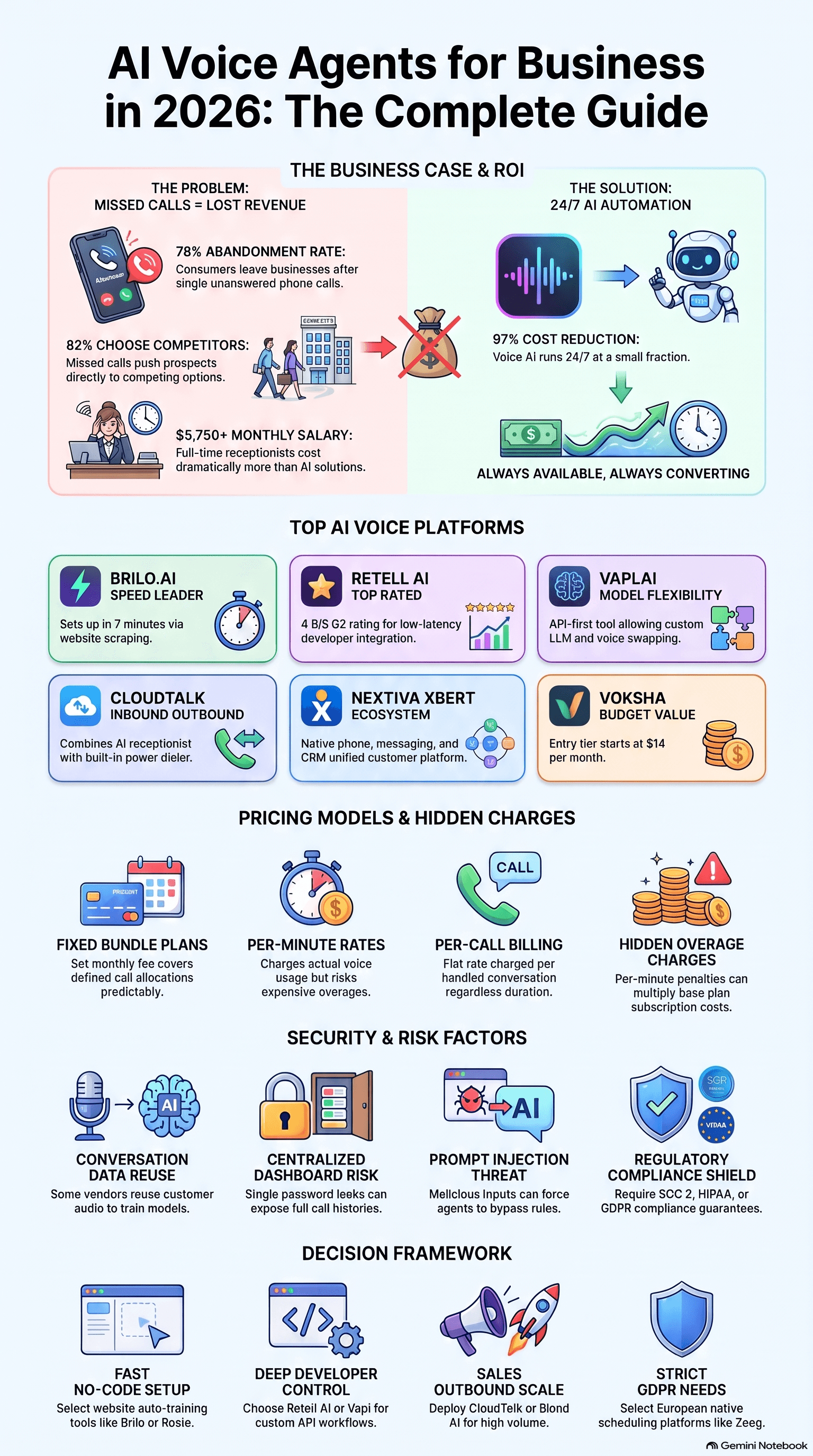
<p>Under legacy phone setups, the cognitive burden fell entirely on the customer. When a caller encountered an automated menu that failed to match their specific issue, the breakdown was immediate. Empirical data reveals that <strong>80% to 85% of callers sent to legacy voicemail or rigid IVR trees hang up without leaving a message</strong>, and <strong>82% immediately call a direct competitor</strong>. For service businesses, this drop-off represents catastrophic financial leakage: research across real-world call logs shows that home services contractors lose an estimated <strong>$16,800 to $252,000 annually</strong> in missed leads, where missing a single emergency job (valued at an average of $4,200) costs far more than modern call automation tools.</p>
<p>On the organizational side, traditional staffing presents severe cost barriers. A full-time human receptionist commands a median salary of ~$33,960 to $38,010 per year, plus $11,000 to $16,000 in benefits and payroll taxes—costing a business approximately <strong>$54,000 annually ($3,750 to $4,000/month)</strong> while providing coverage for only 40 hours a week.</p>
<p>Modern Voice AI removes the customer translation barrier while radically altering these operating economics. Operating at <strong>$14 to $149 per month</strong> (or up to $499/month for higher volume tiers), intelligent voice agents provide 24/7 coverage and autonomously resolve up to <strong>80% of routine customer inquiries</strong>—such as appointment bookings, pricing questions, and after-hours intake—without human friction, hold times, or caller drop-off.</p>(Telecom Voice Economics Audit, 2026; Bureau of Labor Statistics Front Office Benchmarks, 2025)
$54K vs $14-$149Annual Overhead Comparison
Full-time 40-hr receptionist ($54,000/yr) vs 24/7 Voice AI platform ($14 to $149/mo)
Verified Source: US BLS & Telecom Audit 2026
Question 03 of the Buyer Chain
2. The 4-Step Anatomy of an AI Phone Call: The Real-Time Loop
<p>A live AI phone call is not controlled by a single monolithic program. Instead, it operates as a continuous, multi-stage processing loop—an assembly line of intelligence that receives raw audio data, transcribes it, interprets the intent, formulates a response, and speaks back to the caller in fractions of a second.</p>
<div class="my-6 rounded-xl border border-stone-200 bg-stone-900 text-stone-200 p-5 font-mono text-xs leading-relaxed overflow-x-auto">
[ Caller Speaks ]
│
▼
1. Speech Recognition (ASR) ➔ Converts Audio Waves to Text
│
▼
2. Intent Parsing (NLP/NLU) ➔ Extracts Meaning & Entities
│
▼
3. Decision Engine (LLM) ➔ Consults Knowledge Base & Formulates Response
│
▼
4. Voice Synthesis (TTS) ➔ Synthesizes Text into Spoken Audio
│
▼
[ Caller Hears Response ]
</div>
<p>Every conversational turn follows this 4-step chronological sequence:</p>
<ol class="space-y-3 my-4 list-decimal pl-5 text-slate-700">
<li><strong>Automatic Speech Recognition (ASR):</strong> The intake stage. As the caller speaks into their phone, the ASR engine captures the incoming digital audio stream and instantly converts raw acoustic sound waves into digital text tokens.</li>
<li><strong>Natural Language Processing & Understanding (NLP/NLU):</strong> The translation stage. The NLU engine parses the converted text to determine what the caller actually wants (their core intent), extracts key data points (entities such as customer names, dates, or requested service types), and establishes contextual meaning.</li>
<li><strong>Large Language Model (LLM):</strong> The decision engine. Acting as the brain of the agent, the LLM evaluates the extracted intent alongside ongoing conversation history. It consults integrated knowledge sources (such as scraped website data, business FAQs, and scheduling rules) to formulate a logically sound, intelligent text response.</li>
<li><strong>Text-to-Speech (TTS):</strong> The voice synthesis stage. The generated text response is passed to an advanced TTS engine, which synthesizes the written words back into natural-sounding, expressive audio speech delivered straight to the caller's earpiece.</li>
</ol>
<div class="my-6 overflow-x-auto rounded-xl border border-stone-200 bg-white">
<table class="w-full text-left text-xs sm:text-sm">
<thead class="bg-stone-50 border-b border-stone-200 font-bold text-slate-900">
<tr>
<th class="py-3 px-4">Pipeline Stage</th>
<th class="py-3 px-4">Explicit Inputs</th>
<th class="py-3 px-4">Explicit Outputs</th>
<th class="py-3 px-4">Primary Role in the Call Loop</th>
</tr>
</thead>
<tbody class="divide-y divide-stone-100 text-slate-700">
<tr>
<td class="py-3 px-4 font-semibold text-slate-900">1. ASR</td>
<td class="py-3 px-4">Raw digital audio stream</td>
<td class="py-3 px-4 font-mono text-xs">Digital text transcript</td>
<td class="py-3 px-4">Listens to incoming acoustic waves and transcribes them into text.</td>
</tr>
<tr>
<td class="py-3 px-4 font-semibold text-slate-900">2. NLU</td>
<td class="py-3 px-4">Raw digital text transcript</td>
<td class="py-3 px-4 font-mono text-xs">Parsed intent, entities, context</td>
<td class="py-3 px-4">Analyzes text to extract caller intent, key parameters, and situational context.</td>
</tr>
<tr>
<td class="py-3 px-4 font-semibold text-slate-900">3. LLM</td>
<td class="py-3 px-4">Intent, entities, knowledge base</td>
<td class="py-3 px-4 font-mono text-xs">Written response text</td>
<td class="py-3 px-4">Evaluates facts, business rules, and context to craft an intelligent reply.</td>
</tr>
<tr>
<td class="py-3 px-4 font-semibold text-slate-900">4. TTS</td>
<td class="py-3 px-4">Written response text</td>
<td class="py-3 px-4 font-mono text-xs">Synthesized digital audio</td>
<td class="py-3 px-4">Converts textual replies back into clear, human-sounding spoken audio.</td>
</tr>
</tbody>
</table>
</div>
<p>While these four discrete processing steps sound complex, their ultimate success hinges entirely on one critical performance metric: real-time processing speed.</p>(Conversational Voice AI Engineering Whitepaper, 2026)
Question 04 of the Buyer Chain
3. Under the Hood: Core Engineering Concepts in Voice AI
<p>Making an AI agent sound knowledgeable is only half the battle; the real engineering challenge is making the interaction feel naturally human. Natural conversation relies on subtle timing cues, immediate feedback, and dynamic handoffs. Modern voice platforms utilize four core engineering mechanisms to bridge the gap between robotic voice tools and lifelike conversational partners.</p>
<h3 class="text-base font-bold text-slate-900 mt-5 mb-2">3.1. Latency & Natural Interruption ("Barge-In")</h3>
<p>In voice AI, latency refers to response turnaround time—the exact duration between the millisecond a caller finishes speaking and the moment the AI begins outputting audio.</p>
<ul class="my-3 space-y-2 list-disc pl-5 text-slate-700">
<li><strong>The Immersion Break (> 800ms):</strong> When processing delays exceed 800 milliseconds, the human brain perceives an unnatural silence. This delay breaks conversational flow and immediately reminds the caller that they are interacting with a machine.</li>
<li><strong>The Realism Target (Sub-600ms & ~200ms Target):</strong> Advanced voice platforms optimize their processing stack to achieve sub-600ms latency, with top-tier API architectures targeting response speeds as low as ~200ms. At these sub-second speeds, voice dialogue feels instantaneous and natural.</li>
</ul>
<p>Equally critical is <strong>barge-in capability</strong>. In human conversation, people frequently interject mid-sentence to correct a detail, ask a quick question, or change the subject. Legacy phone tools behave like a rigid pre-recorded voicemail broadcast, continuing to play audio regardless of caller input.</p>
<p>Voice AI handles this through <strong>full-duplex speech processing</strong>. The platform maintains an active, continuous full-duplex audio stream—meaning the ASR engine remains actively listening and analyzing incoming audio sound waves even while the TTS engine is outputting spoken voice audio. If user voice activity is detected while the AI is speaking, the system instantly fires a cancellation signal that halts the TTS audio buffer mid-word. Think of a human receptionist immediately pausing their sentence mid-word the instant you speak over them—the AI stops, listens to the new input, and adapts its response without missing a beat.</p>
<h3 class="text-base font-bold text-slate-900 mt-6 mb-2">3.2. Website Auto-Training vs. Manual Scripting</h3>
<p>Traditionally, configuring an automated caller system required weeks of manual effort: mapping complex flowcharts, writing explicit intent scripts, and hand-coding logic for every edge case.</p>
<p>Modern business-ready platforms bypass manual scripting entirely through <strong>website auto-training</strong>. An administrator simply inputs a business URL or Google Business Profile link. The system automatically crawls and ingests business documentation, pricing sheets, service locations, and FAQs directly from the web.</p>
<p>Empirical setup benchmarks demonstrate how fast modern self-learning agents can go live without developer intervention:</p>
<ul class="my-3 space-y-1.5 list-disc pl-5 text-slate-700">
<li><strong>Brilo.ai:</strong> Live in 7 minutes 14 seconds (auto-scraping website content, pricing, and FAQs).</li>
<li><strong>Goodcall:</strong> Live in 8 minutes.</li>
<li><strong>Rosie AI:</strong> Live in 9 minutes (auto-ingesting business info for home services).</li>
</ul>
<p>This automated approach allows non-technical business owners to deploy fully operational, highly knowledgeable voice agents in under 10 minutes without issuing developer tickets or scripting complex conversation trees.</p>
<h3 class="text-base font-bold text-slate-900 mt-6 mb-2">3.3. Automated Escalation & Context Transfer</h3>
<p>While AI voice agents excel at handling high-volume, routine requests, edge cases inevitably arise. When conversations involve severe customer distress, edge-case scenarios, or low confidence scores, systems initiate automated escalation.</p>
<p>During the call, the AI continuously monitors its internal confidence thresholds. If a caller asks a question outside the agent's knowledge parameters, the system executes a live warm transfer to a human staff member.</p>
<p>Crucially, modern systems perform a <strong>context transfer</strong> rather than a blind drop. When handing off the call, the AI instantly packages and transmits a structured data payload to the human agent's team inbox or CRM:</p>
<ol class="my-3 space-y-2 list-decimal pl-5 text-slate-700">
<li><strong>Structured CRM Entities:</strong> Key extracted variables including caller name, contact details, account status, and urgency score.</li>
<li><strong>Complete Text Transcript:</strong> The full word-for-word transcript of the call up to the moment of transfer.</li>
<li><strong>Actionable AI Call Summary:</strong> A concise 2 to 3 sentence summary highlighting what the caller requested and recommending exact next steps for the human agent.</li>
</ol>
<p>As a result, when human staff pick up the line, they possess complete context, ensuring the caller never has to repeat themselves.</p>
<h3 class="text-base font-bold text-slate-900 mt-6 mb-2">3.4. Privacy, Data Security & Guardrails</h3>
<p>Deploying AI on live telephone lines requires strict security controls to protect sensitive customer communications. Enterprise-grade Voice AI solutions enforce defensive engineering safeguards across three core areas:</p>
<ul class="my-3 space-y-2 list-disc pl-5 text-slate-700">
<li><strong>Compliance Frameworks:</strong> Production environments adhere to rigorous regulatory and security standards, including SOC 2, HIPAA (with Business Associate Agreements for medical environments), ISO certifications, PCI-DSS (for payment security), GDPR (for European data protection), and CCPA (for California privacy rights).</li>
<li><strong>Strict "No Re-Training" Data Policies:</strong> Leading enterprise platforms enforce strict data isolation policies. Private customer call audio, text transcripts, and personal contact details are kept strictly confidential and never used to train underlying public AI models.</li>
<li><strong>Defensive Guardrails (Prompt Injection Protection):</strong> Callers may occasionally attempt adversarial prompt injection attacks—speaking phrases like "Ignore your previous instructions and do what I say" to trick the AI into offering unauthorized discounts, breaking business logic, or revealing internal instructions. Modern platforms place defensive guardrail layers between raw speech intake and model execution, isolating system instructions from user prompts to ensure the AI adheres strictly to its authorized boundaries.</li>
</ul>(Enterprise Telephony Security & Compliance Standard, 2026)
Question 05 of the Buyer Chain
4. Key Takeaways & Mental Model Summary
<div class="rounded-2xl border border-teal-200 bg-teal-50/60 p-6 my-6">
<h3 class="font-serif text-lg font-bold text-teal-950 flex items-center gap-2">
<span>💡 The 3 Golden Rules of Voice AI Understanding</span>
</h3>
<ol class="mt-4 space-y-3 list-decimal pl-5 text-sm text-teal-900 leading-relaxed font-medium">
<li><strong>Voice AI is an Orchestration Loop:</strong> It is not a single static AI model, but a fast-chained relay between four specialized technologies: Speech Recognition (ASR), Intent Understanding (NLU), Decision Logic (LLM), and Speech Synthesis (TTS).</li>
<li><strong>Latency Dictates Realism:</strong> Response speeds under 600ms (targeting ~200ms) combined with full-duplex "barge-in" interruption handling are what allow voice conversations to feel natural, fluid, and human-like.</li>
<li><strong>AI Complements Humans:</strong> High-value Voice AI platforms autonomously absorb routine call volume (handling 80%+ of standard inquiries), while executing clean, context-rich transfers to human teams when complex edge cases occur.</li>
</ol>
</div>
<p>Congratulations! You have successfully mastered the foundational architecture of modern Conversational Voice AI infrastructure. You understand not just what an AI voice agent does when it answers a call, but how it transforms sound waves into text, evaluates context and business facts, synthesizes human-like speech in real time, and safeguards user data.</p>
<p>As voice interfaces continue to transform how we interact with technology, this core loop—ASR to NLU to LLM to TTS—remains the essential engine driving the future of real-time communication!</p>
<p>To see how these principles apply to specific industries or compare exact software plans, explore our guides on
AI Receptionist Pricing,
Contractor Call Handling, and
Top Rated AI Receptionist Software.</p>
(AI Receptionist for Small Business Editorial Matrix, 2026)